Tyre labels
Rubber is greasy, rough and low-energy all at once. Only the heaviest artillery among adhesives holds on it.
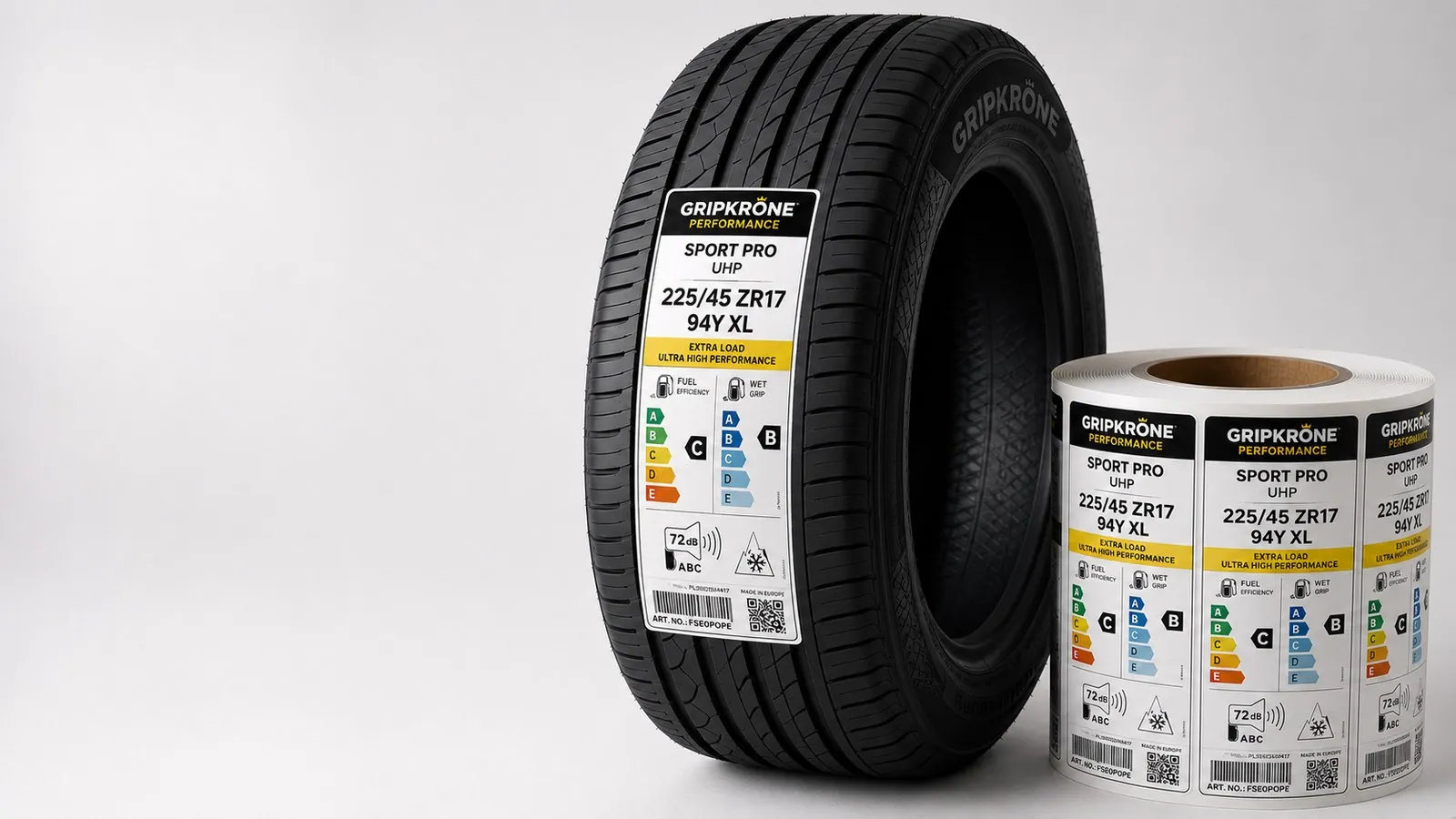
Every tyre sold in the EU must carry a label compliant with Regulation 1222/2009: legible classes for fuel efficiency, wet grip and noise. The problem is that the tread combines everything an adhesive dislikes — release agent residue from the mould, components migrating from the rubber, roughness and low surface energy.
That is why tyre labels get the strongest adhesives we use at all — with an initial tack of around 35 N/25 mm, four to five times higher than a standard permanent adhesive. The facestock is aluminium-foil laminated paper or white PP, which stay flat on the curve of the tread. Barcodes and QR codes in a quality that scans first time, also for automatic application.
Good to know
For workshops and distributors only one thing matters: the label has to go on fast, hold firmly and scan first time — even in winter in an unheated warehouse. For manufacturers we have separate constructions for application directly on the production line.
What you can choose from
Aluminium-laminated paper
The aluminium layer gives the label “shape memory” — it stays flat on the curve of the tread instead of springing back with the paper.
White cavitated PP
The film alternative: resistant to moisture and abrasion, with a top coating for sharp printing of classes and codes.
Termiczne Top
The version for overprinting variable data on the production line — size, item number, batch code straight from a thermal printer.
The adhesive does half the work
Extra-permanent for rubber
The strongest class of adhesive we use — initial tack around 35 N/25 mm, four to five times higher than standard.
Resistant to release agents
A tread fresh from the mould carries release agent residue and components migrating from the rubber — the adhesive has to tolerate them, not fight them.
For production and aftermarket
Different formulations for the vulcanisation line (high temperature), different ones for labelling finished tyres in the warehouse.
You do not need to know these terms — just tell us what the label has to stick to and the conditions it will live in. Our technologist will choose the rest.
You may also be interested in