Deep-freeze labels
A freezer is frost, ice and moisture at once. Ordinary adhesive hardens and lets go — deep-freeze holds.
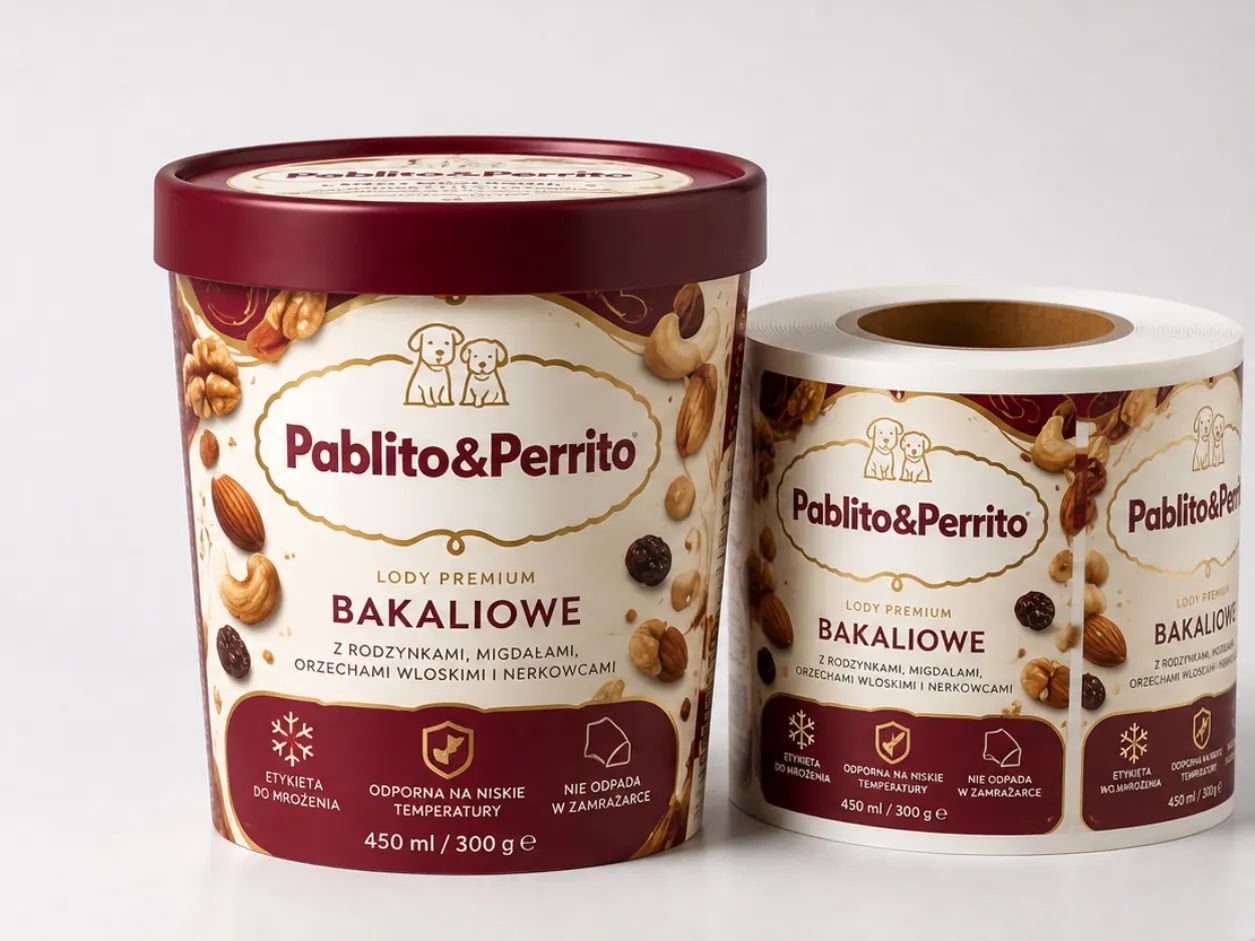
At low temperatures adhesives harden and lose tack — most standard constructions can only be applied above +5°C. Deep-freeze adhesives bond to a cold, damp or frosted surface; special formulations allow labelling of already packed, frozen goods at down to −25°C — without thawing.
We choose the facestock and varnishes so they do not crack in frost, and we print with low-migration inks — far safer for food-industry labels than conventional UV inks and compliant with EU standards. And if we ever need to go lower: there are adhesives that work down to −196°C, in liquid nitrogen.
Good to know
The most important question we will ask: do you label before or after freezing? That changes the adhesive choice more than anything else. We also label packs that are already frosted — everyday practice in the fish market, for instance — so the freezer really is no obstacle for us.
What you can choose from
Frost-resistant PP / PE films
Do not go brittle or crack in frost; resistant to moisture and ice. The basis of ice cream and frozen food labels.
Cavitated PP
A foamed structure — light, rigid, insulates the print well from the cold, damp surface.
Freezer papers
Coated papers with varnishes that stay flexible at low temperatures — the economical option for frozen food cartons.
The adhesive does half the work
Deep-freeze
Bonds to a cold, damp, even frosted surface. Special formulations allow labelling of frozen goods at −25°C — without thawing.
Chilled
For the chilled counter and cold chain (0…+8°C) — cheaper than deep-freeze and sufficient when the goods never pass through a freezer.
Cryogenic (to order)
The extreme end of the scale: adhesives that work in dry ice (−80°C) and even liquid nitrogen (−196°C) — pharma, biobanks.
You do not need to know these terms — just tell us what the label has to stick to and the conditions it will live in. Our technologist will choose the rest.
You may also be interested in