Clear labels
A bottle straight from the fridge, condensation on the glass — and the label still “invisible”. That is the no-label look done right.
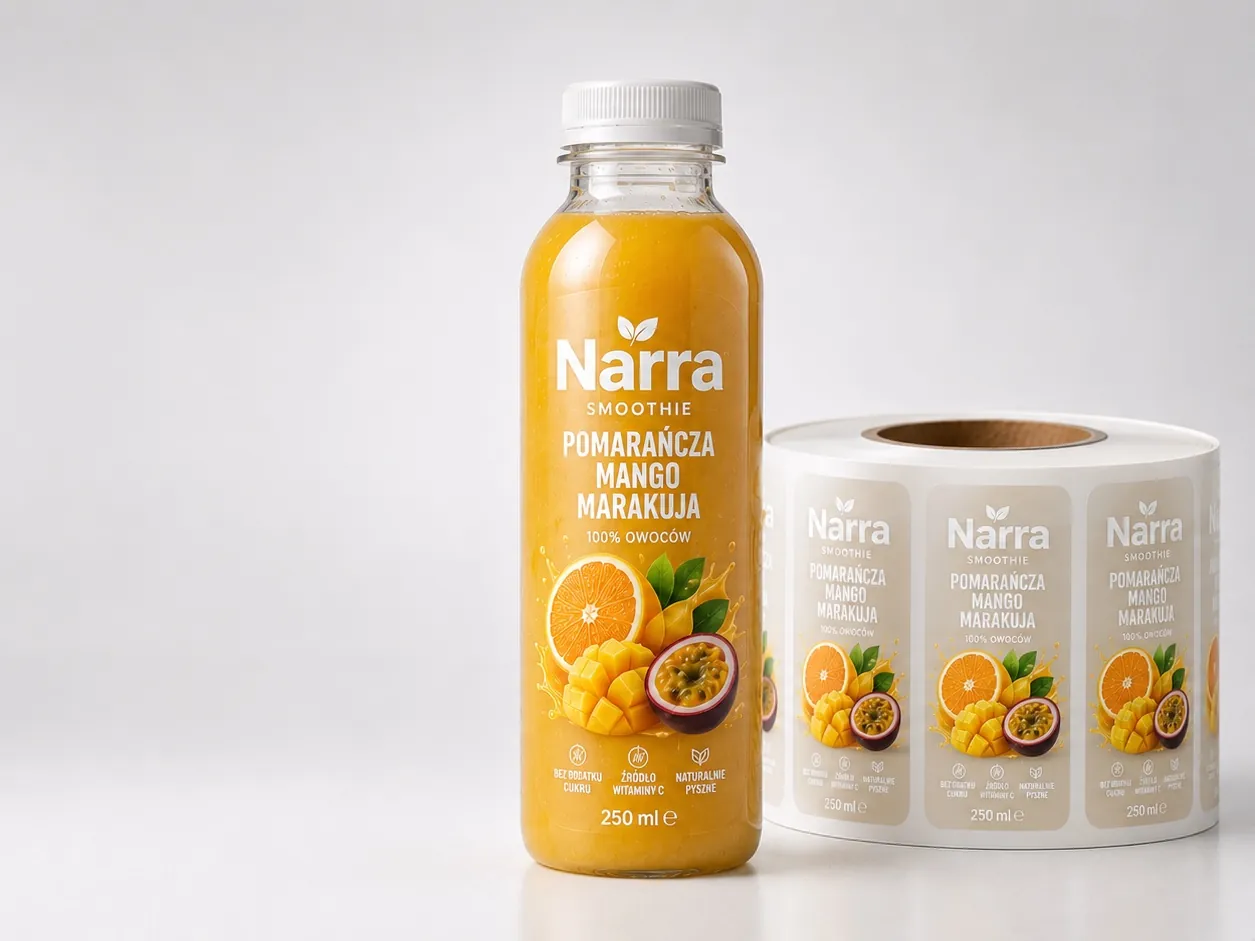
When the contents sell themselves — juice, water, cosmetics in glass — the label should disappear. Clear film gives the effect of printing directly on the pack: the customer sees the product and the artwork “floats” on the bottle. The whole trick is making the effect survive the fridge.
That is why we use high-clarity adhesives resistant to water-whitening from water and condensation, with limited edge ooze, and opaque white laid selectively under the artwork. On request, a wash-off construction: the label comes off in industrial washing and the PET bottle returns to circulation as a full-value raw material.
Good to know
Fun fact: the no-label look was born in the late 1980s, when clear films were first combined with clear liners — and it has been winning the water, juice and cosmetics shelves ever since. When designing, you only decide what stays “glass” and what becomes artwork — the rest is handled by white ink under the chosen elements.
What you can choose from
PP crystal clear
Highest transparency and rigidity — the label “disappears” on glass and rigid PET. The basis of the classic no-label look.
Clear PE
The flexible version for soft, squeezable bottles — a clear effect without wrinkling when squeezed.
Constructions on PET liner
A thinner, stronger film liner allows fast, precise machine application and a perfectly clean label edge.
Wash-off
The recycling variant: the label separates in industrial washing and the PET or glass bottle returns to circulation without adhesive residue.
The adhesive does half the work
Ultra-clear
Invisible under the film — no streaks, bubbles or “frame” at the edge thanks to limited adhesive ooze.
Resistant to water-whitening
Fridge condensation can turn ordinary adhesive milky and kill the whole effect. We use formulations that stay clear in moisture and water.
For pasteurisation
Withstands the pasteurisation bath — the label is clear before and after the process.
You do not need to know these terms — just tell us what the label has to stick to and the conditions it will live in. Our technologist will choose the rest.
You may also be interested in