Labels for difficult surfaces
On a rough surface a hard adhesive touches only the peaks. A soft one fills them completely.
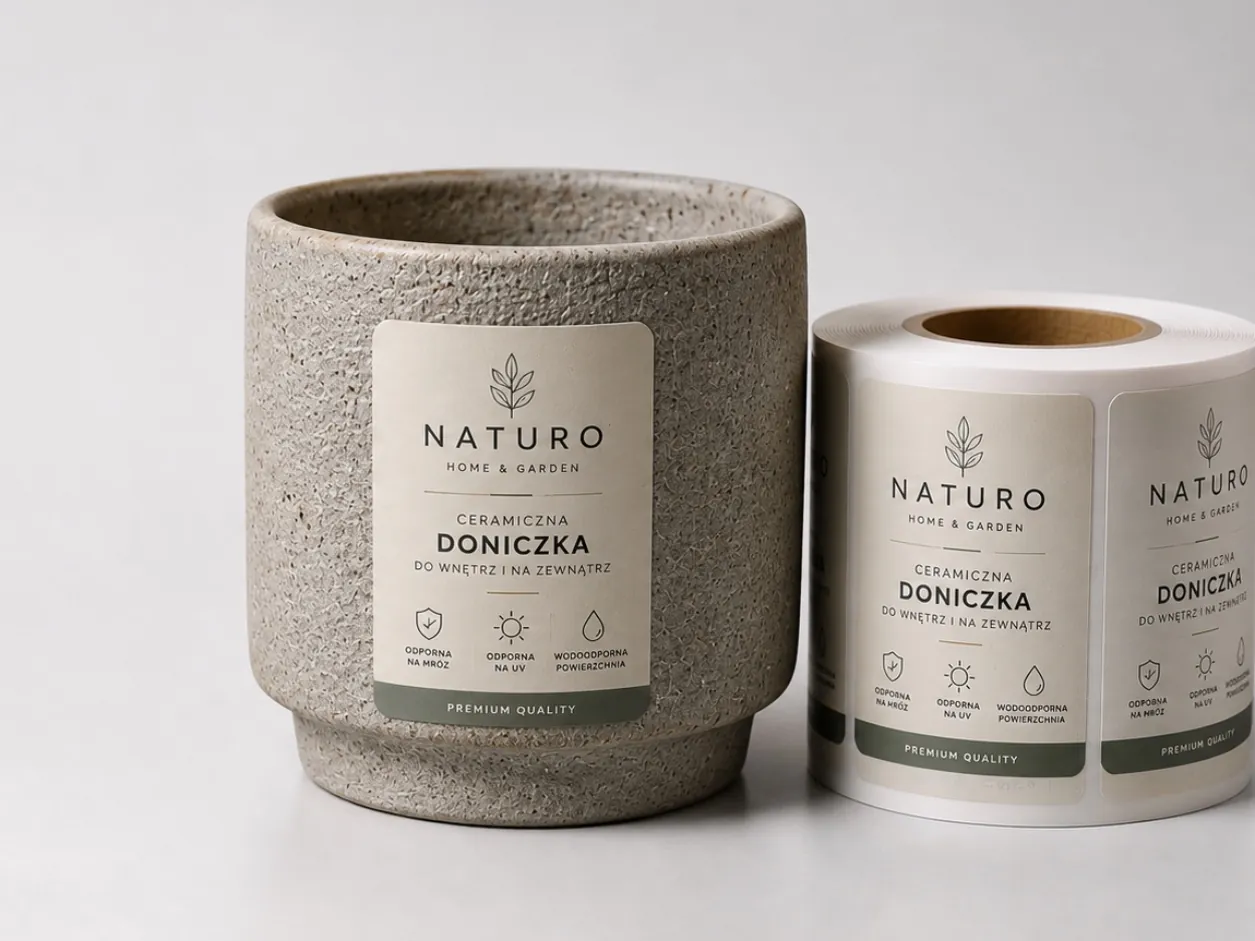
A rough surface is a trap: a hard adhesive only touches the peaks of the unevenness and the label can fall off while still in the warehouse. For raw ceramics, concrete, wood or egg cartons we use soft rubber-based adhesives with an initial tack up to three times higher than standard — they flow into the micropores and genuinely increase the contact area.
If the product stands outdoors — like a plant pot on a terrace — we add UV, frost and water resistance on the facestock and varnish side. A curiosity from the opposite end: we also have constructions for surfaces as smooth and difficult at once as a melon skin — an aluminium-laminate label sticks to it directly, food-contact approved.
Good to know
The surest route to a good result: send us a sample of the surface — a piece of board, a pot, a sack. An adhesive test on the real surface before production costs little and can save a whole batch. That is how we work with every unusual job.
What you can choose from
Folie PP / PE
Resistant to moisture and tearing — for garden, construction and industrial packaging.
Coated and textured papers
When a product on a difficult surface has to look premium — like a ceramic pot in a garden centre.
UV-resistant materials
Varnishes and films that do not yellow or fade outdoors — terrace, garden, building site.
Aluminium laminates for fruit
Paper with an aluminium layer and a food-contact approved adhesive — the label sticks directly to the skin of a melon or kiwi.
The adhesive does half the work
High-tack rubber-based
Initial tack up to three times higher than standard — the soft adhesive flows into the micropores and genuinely increases the contact area.
For porous surfaces
Raw ceramics, concrete, wood, egg cartons — surfaces that “drink up” ordinary adhesive.
For dusty and oily surfaces
Formulations that tolerate contamination that cannot be removed before labelling — pallets, drums, sacks.
Resistant to UV, moisture and frost
For labels that have to hang outdoors for a season or longer.
You do not need to know these terms — just tell us what the label has to stick to and the conditions it will live in. Our technologist will choose the rest.
You may also be interested in